




Textual content-based video modifying is nice, however chat modifying could be even higher. On this undertaking, I’ve in contrast two totally different workflows: text-based video modifying and chat modifying to grasp which of those AI modifying strategies saves extra time and is general extra environment friendly.
My fast verdict is that text-based video modifying is nice, however in all probability higher suited to YouTube initiatives, interviews, or related footage. Chat-based modifying is general simpler and faster, because it simply looks like a private assistant.
Now, how did I come to this conclusion? Right here’s my thought course of deciphered for you!
Transcript modifying vs AI modifying with chat
First, as regular, let’s have a fast recap of what every of those phrases means:
Textual content-based video modifying is like modifying your video the identical means you’d edit a textual content doc. For instance, in case you don’t have time to undergo half-hour of footage, you possibly can flip it right into a transcript and simply discover the elements you want and wish to preserve and the elements you wish to take away. Every thing that you just wish to do away with will be merely deleted from the video undertaking by simply deleting the sentence out of your transcript.
Now, if text-based modifying was about first getting your transcript after which eradicating elements out of your video by modifying your textual content, a conversational video editor is if you actually chat along with your editor. In different phrases, you inform your video editor precisely what you wish to edit, the way you wish to improve it, what particular duties you need it to carry out, and so forth. It’s principally your private assistant and video editor who does the whole lot for you.
Whereas each workflows are nice for inexperienced persons, every has its personal strengths and weaknesses and works higher for sure varieties of initiatives. So, to seek out out which one really comes out on high, we examined each on the identical footage and introduced you the receipts!
How I examined each AI video modifying workflows
For this comparability, I used Async to check each text-based video modifying and chat-based modifying. I needed to maintain issues truthful, so this is how I approached the experiment:
- Identical footage: I used the very same video for each checks.
- Identical video editor: Each workflows had been examined in Async, so I might deal with the modifying expertise itself.
- Totally different modifying duties: I began with transcript modifying after which moved on to some extra inventive modifications by chat.
- What I checked out: How simple every workflow was to make use of, how a lot management I had over the edits, and naturally, how good the outcomes had been.
I did not time both workflow, so this comparability relies on my precise modifying expertise somewhat than a velocity take a look at.
I’ve additionally included the prompts I used and screenshots of the outcomes, so you possibly can comply with the entire experiment and determine which workflow you’d desire in your personal initiatives.
Testing Async’s text-based video modifying
Each of those workflows can be found at Async, so I’ve began by merely importing the footage into our video editor. Out of your foremost dashboard, click on on Edit video with AI or add your footage instantly within the chat editor.

Now, as soon as your video is uploaded, inform Async, “I would like you to assist me edit my video by modifying the transcript.” Now, in idea, we’re already working with a chat editor, since prompting your video editor counts as conversational modifying.
However for now, let’s ask it to assist us edit our video by modifying the transcript.
First, it should ask you why precisely you need this performance. For me, it’s extra about discovering particular traces within the video and eradicating these, so I’ll go together with that one, however you would additionally decide eradicating silence fillers, repeated unhealthy takes, and so forth.

When you decide your choices, for the very best outcomes, additionally immediate the editor with one thing like “Give me the transcript of the video and like a text-based video editor the place I can edit my video by modifying the transcript.”
After your immediate, Async provides you with the complete transcript of your video and ask you the way you wish to edit your transcript.

Here’s what the AI editor instructed to me:
The best way to edit
• Delete: “delete traces 23–25,” or “take away the sentence about GPT picture two”.
• Take away phrases: “minimize the phrase ‘really’ in line 10”.
• Reorder: “transfer line 51 earlier than line 49”.
• Trim: “preserve solely the primary half of line 39”.
Now, these are solely examples of how you would work with the AI editor, simply to information you on what the text-editing workflow appears to be like like.
For me, for instance, I simply needed to take away the half about Nano Banana as a result of we wish to swap it with one thing else afterward.
That is the precise case the place the textual content editor turns out to be useful, as all I’ve to do is press Command + F on a Mac (or Ctrl + F on Home windows/PC) to seek out the time period “Nano Banana”, and it reveals me all of the locations within the script the place we talked about it.

As soon as I find the place in my transcript I discussed Nano Banana, it makes it a lot simpler for me to determine what to maintain or take away.
From right here, all I’ve to do is inform Async which traces you wish to be minimize out from my transcript, and it’ll take away these out of your ultimate video too.
Now, that is my favorite half as a result of it is loopy how easy it’s and the way good the AI textual content editor is at its job.
I needed to take away traces 7 and 10, so as soon as I prompted the video editor, it made the cuts so easily that you just’d by no means even guess Nano Banana had been talked about within the first place.
This is the immediate:

And this is a close-up of our timeline so you possibly can see the minimize in 4K:

See the little minimize there within the center? It is Async’s AI video editor at its finest.
So, my verdict right here is that text-based modifying works finest in case your foremost modifying activity is to take away or substitute sure elements of your video. This might additionally imply eliminating silences or filler phrases with out having to manually find each single one after which determine how you can make the proper minimize.
The textual content editor finds what you wish to take away, cuts it out, and makes certain the video nonetheless appears to be like good afterwards. Which, as you possibly can see from our Nano Banana instance, it does fairly effectively!
If that is often the kind of modifying you want in your initiatives, I believe a text-based editor would possibly simply turn out to be your finest buddy.
Now, for these of you who need just a little extra out of your AI editor than simply eradicating elements and tidying issues up, the following part is all about chat-based modifying.
Testing Async’s chat-based video modifying
I personally discover chat-based modifying much more attention-grabbing as a result of there’s a lot extra you are able to do along with your video right here.
I am nonetheless working with the identical footage, however this time I received’t be searching for particular traces within the transcript.
As a substitute, I’ll simply inform Async what I wish to change within the video and let it determine how you can make these edits. I needed to start out with eradicating the background, which is one thing that might usually require a bit extra work in case you’re modifying manually.
So, I went straight to the chat and prompted Async with “Take away the background from my video from second 10-12.”And that’s just about all that you must do.

After eradicating the background, I needed to attempt one thing a bit extra enjoyable and see how far I might push the editor, so I requested Async so as to add a fort behind her.
For this, my immediate was “Add a fort background behind her.”
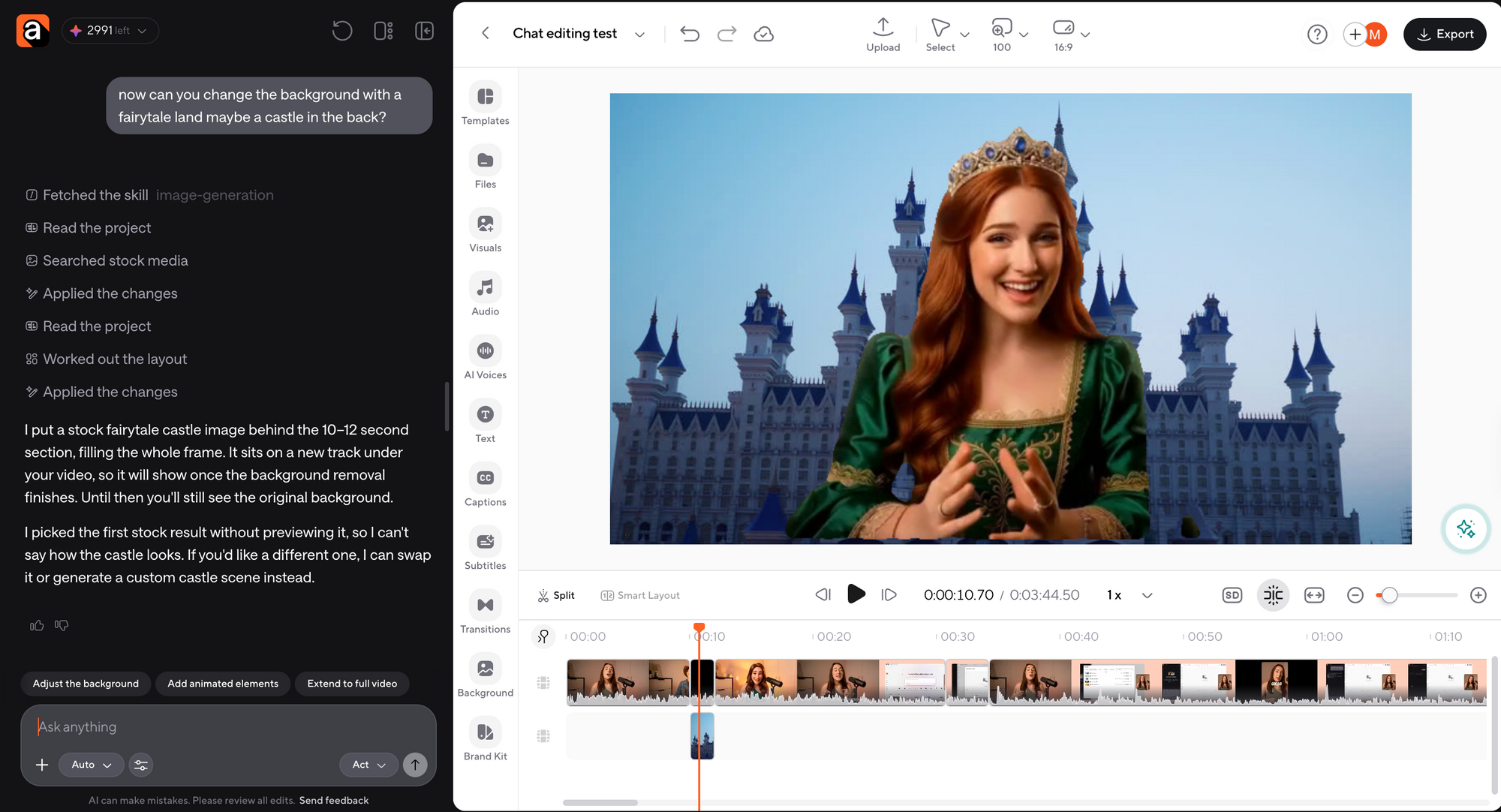
I preferred this take a look at as a result of we’re really altering the entire setting and giving the scene a very totally different look.
Subsequent, I attempted asking the editor to take away an precise object from the footage whereas protecting the remainder of the scene. For this, my immediate was simply “Take away the microphone from my video in 0:05 sec.”
This is what it gave me:

And eventually, I needed so as to add subtitles. That is in all probability one of many extra widespread modifying duties, particularly in case you’re making movies for social media, and one thing I actually wouldn’t wish to spend time doing manually.
So I requested Async so as to add subtitles to the video, with out having to sort out the whole lot that was stated or attempt to match every line with the audio myself.
And voila!
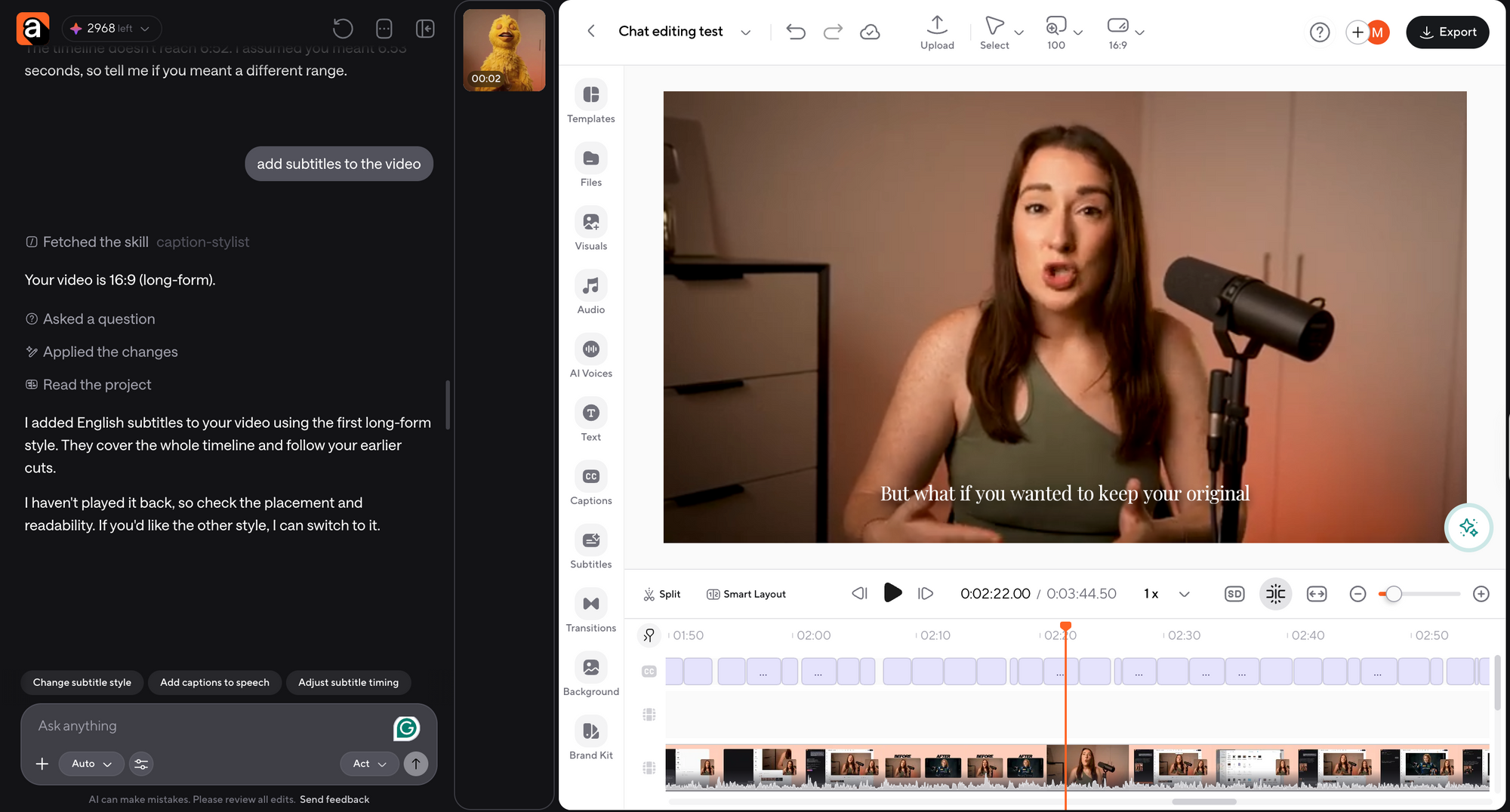
Pure magic. Once more, keep in mind that the whole lot on this workflow will be customised much more afterward. You possibly can simply change the subtitles’ font, color, and sizing, however this offers you an excellent begin.
Now, I might go on and on about what you are able to do with the chat-based editor, as a result of there’s truthfully a lot extra to attempt. However I believe we have examined sufficient to return to a conclusion.
For me personally, conversational modifying was the higher workflow for 2 causes: a) it already has transcript modifying constructed into it, so I can nonetheless use that each time I must, and b) it offers me far more freedom to experiment with my video, with out making the modifying course of difficult.
Total, I nonetheless suppose text-based modifying is nice for cleansing up longer recordings, however I desire having extra management over the entire video and having the ability to make modifications as I am going.
Ultimate Take
So, after making an attempt each workflows on the identical footage, chat-based modifying is my private winner. I believe text-based modifying did an ideal job, particularly once I needed to take away particular traces from my recording. The cuts had been easy, and the entire course of was surprisingly easy.
I can undoubtedly see myself utilizing it once more for longer YouTube movies or interviews, the place many of the modifying includes cleansing up what you have recorded.
However for my very own initiatives, I might in all probability go straight to chat-based modifying. I had much more freedom to experiment with the footage, and I actually preferred having the ability to ask Async for various modifications each time I had a brand new concept. Plus, transcript modifying is already accessible throughout the chat editor, so I can nonetheless use it each time I must.
This is a fast comparability of each workflows primarily based on my take a look at:
Now, one factor price mentioning is that I did not time the 2 workflows, and I additionally gave them totally different modifying duties. So this comparability is extra about my precise modifying expertise and which method I discovered extra helpful.
For me, chat-based modifying wins as a result of I like having the ability to direct the editor all through the entire undertaking. And understanding that I also can work with my transcript each time I must makes it an excellent simpler selection.
That stated, if most of your modifying includes chopping out undesirable elements from an extended recording, I might nonetheless fortunately suggest text-based modifying. It did precisely what I wanted it to do in our take a look at, and I believe that is a reasonably good cause to maintain utilizing it!
FAQ
What’s the distinction between text-based and chat-based video modifying?
Textual content-based video modifying permits customers to edit video footage by modifying its transcript. Deleting or rearranging textual content robotically updates the corresponding video segments. Chat-based video modifying makes use of natural-language prompts to carry out modifying duties, equivalent to eradicating undesirable footage, altering backgrounds, or including subtitles.
Is text-based video modifying good for YouTube movies?
Sure, text-based video modifying is especially helpful for YouTube movies, interviews, podcasts, and different long-form content material. It permits creators to find particular dialogue, take away pointless sections, and clear up recordings instantly by the transcript. This makes it a sensible possibility for modifying movies with massive quantities of spoken content material.
Can AI edit movies utilizing textual content prompts?
Sure, AI video editors with conversational modifying capabilities can carry out supported modifying duties by textual content prompts. For instance, customers can ask an AI editor like Async to take away a video background, add subtitles, or take away undesirable objects from footage. The accessible modifying capabilities rely upon the platform.
Can chat-based video editors additionally carry out transcript modifying?
Sure, some chat-based video editors, together with Async, assist transcript-based modifying throughout the conversational workflow. Customers can request a video transcript, establish particular sentences, and instruct the editor to take away or modify corresponding sections of the footage. This enables each modifying strategies for use throughout the identical undertaking.
Which is quicker: text-based video modifying or chat-based modifying?
The quicker workflow depends upon the modifying activity. Textual content-based video modifying is especially environment friendly for finding and eradicating dialogue from lengthy recordings. Chat-based modifying provides higher flexibility for initiatives requiring several types of edits, together with visible modifications. The comparability on this article relies on hands-on expertise somewhat than measured modifying occasions.
